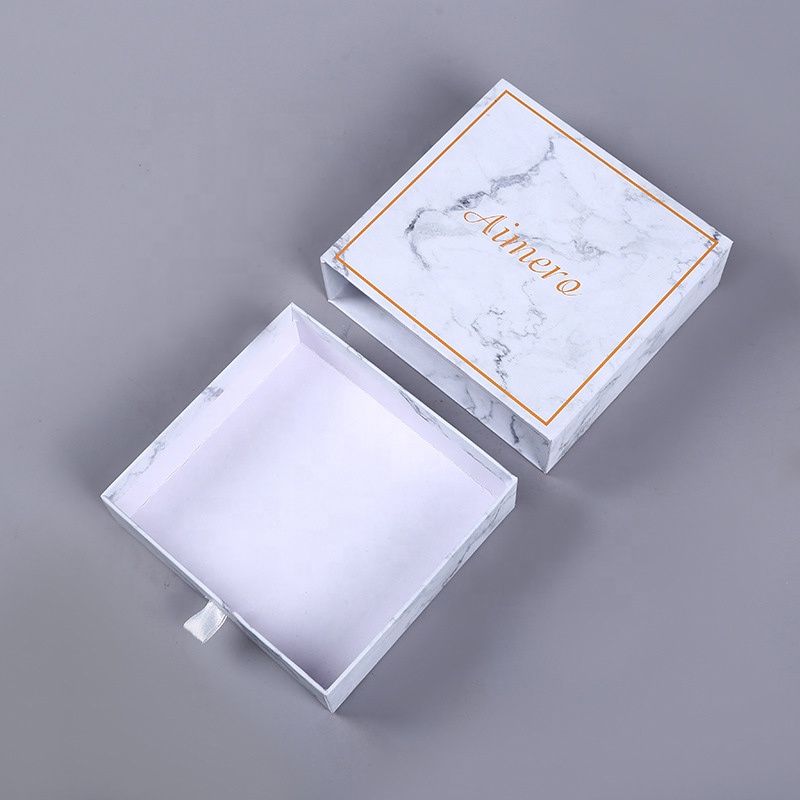

A double-door box opens from both sides at once, which sounds like a small structural detail and is actually the whole reason it works as a gift. The recipient pulls one edge, both doors swing out, and the contents are revealed in a single gesture instead of being lifted out of a lid. It is the closest thing in paper packaging to a curtain opening.
What Double Door Actually Means Structurally
Three parts, not one. A base tray holds the product. Two door panels are hinged on opposite edges of the base and fold up to meet at the centre, where magnets hold them shut. A wrap covers the whole assembly, and the doors are formed by the wrap tension rather than by separate board panels on the outside.
The consequence is that the base carries all the structural load, and the doors carry none. That is why a double-door box can use a relatively thin door panel and still feel substantial when closed: your hand feels the magnets and the base, not the door.
Board and Wrap
The specification we build most often is 1200 gsm greyboard wrapped in art paper, with the wrap printed before mounting. 1200 gsm is about 1.5 mm caliper — thick enough to resist flexing under the magnet pull, thin enough that the door still hinges without cracking the wrap.
| Component | Specification | Why it matters |
|---|---|---|
| Base board | 1200 gsm greyboard, 1.4–1.6 mm | Carries the load; too thin and the box twists |
| Door board | 1000–1200 gsm | Hinges repeatedly without cracking |
| Wrap | 157 g art paper, printed, matte or gloss laminated | A laminated wrap survives handling; an unlaminated one scuffs at the door edges |
| Magnet | 2 × N35 discs, one per door | Enough to hold a 200 mm door; four if the box is large |
| Insert | Die-cut card or EVA | Stops the product sliding when the doors open |
The magnet count is worth arguing about. Two magnets, one on each door, is the standard and gives a satisfying snap. Four — two per door — is for boxes above about 250 mm, where a single pair leaves the outer corners of the doors slightly proud. Going to stronger magnets instead of more of them is the wrong fix: it makes the box hard to open without improving how the door sits.
Five Stock Sizes and What Fits
| Size (cm) | Internal volume | Fits | Best for |
|---|---|---|---|
| 15 × 12 × 6 | ~1.1 L | A ring box, a small bottle, a folded scarf | Jewellery, perfume minis |
| 20 × 18 × 7 | ~2.5 L | A folded shirt, two 100 ml bottles | Cosmetics sets, small gifts |
| 20 × 18 × 10 | ~3.6 L | A mug with packaging, a candle jar | Home fragrance, ceramics |
| 29 × 21 × 9 | ~5.5 L | A pair of shoes, a folded knit | Footwear, apparel |
| 33 × 25 × 14 | ~11.6 L | A handbag, a boxed appliance, a gift hamper | Luxury retail, hampers |
These are internal dimensions. A 33 × 25 × 14 cm box occupies considerably more than that in a shipping carton, which is why foldable structures exist for export volumes.
Where the Gradient Comes From
A gradient across a door panel is usually printed, not achieved with special paper. Four-colour process printing handles a smooth two-colour gradient well on coated stock, and the door panel is small enough that the transition stays clean.
Two caveats. A gradient printed across a fold will show a slightly different tone either side of the crease, because the paper compresses there; keep the transition off the hinge line. And a gradient into a very light colour, near white, will band visibly on uncoated stock — that job wants a coated sheet or a coated art paper with lamination.
Assembly and Packing Time
A double-door box is assembled by hand: the base is glued and wrapped, the doors are folded into position while the wrap is still flexible, and the magnets are set before the wrap closes over them. That sequence is roughly 2–3 minutes per unit at the factory, which is why the structure sits above a simple lift-off lid on cost and why order quantities under a few hundred carry a noticeable per-unit premium.
For the buyer, the practical point is that a double-door box cannot be flat-packed. It arrives assembled and occupies its full volume in the carton, so freight planning has to account for a box that is mostly air — the same problem that makes rigid boxes expensive to ship.
Quality Checks Before Shipment
- Door closure. Both doors should meet within 0.5 mm at the centre with no light visible through the gap, held by magnets alone and with no hand pressure.
- Hinge crease. Open and close 20 times. Any whitening along the hinge is a wrap that will crack in use.
- Base rigidity. Load the box with its rated contents, lift it by one door edge. The base should not flex visibly; if it does, the board caliper is underspecified.
- Print alignment across the doors. A gradient or pattern that runs across both doors must line up when closed — the tolerance is the same as any two-colour registration.
Where It Suits and Where It Does Not
Double door suits a reveal: a single product, presented. It is poor for anything where the recipient needs to see several items at once, because the doors themselves obscure the outer edges of the base. It is also a poor choice for a product that will be shipped inside it — the doors are the weakest part of the structure and a courier will find them.
For a multi-item gift set, a magnetic closure box with a lift-off lid shows the whole arrangement at once. For a box that has to travel and then be presented, a two-piece foldable structure with a rigid insert is the usual compromise.