
Rigid boxes are the packaging most brands reach for when the unboxing has to carry the price. Within that family there are three structures that come up in almost every brief: the magnetic closure box, the collapsible rigid box and the sliding drawer box. They look similar in a photo and behave completely differently in freight, in a retail environment and in the customer’s hands. This guide sets out how each is built, what it costs you in shipping volume, and how to choose.
What a magnetic closure box is
A magnetic closure box, also called a magnetic lid-and-base box or set-up box, is built from greyboard wrapped in printed paper. The board gives the structure its rigidity; the wrap paper carries the print. Magnets are buried between the board and the wrap, usually two on the front edge and sometimes four, so they are invisible from both inside and outside.
That construction is why rigid boxes feel different from folding cartons: nothing is printed directly onto the structural board, and the wrap can be as plain or as luxurious as the brief requires. It is also why the same box can be produced at very different price points without changing its shape.
Typical uses are the ones where the box is part of the product: cosmetics and skincare sets, fragrance, jewellery, small leather goods, premium confectionery, electronics accessories.
The four magnetic constructions
| Structure | How it opens | Strength | Weakness |
|---|---|---|---|
| Lid and base (two-piece) | Lid lifts off vertically | Simplest, cheapest rigid build; strong walls | No hinge, so the lid must be lifted with both hands |
| Book-style / hinged lid | Lid hinged along one edge, magnet holds it shut | Premium reveal, holds artwork across the spine | Hinge is the first point of wear |
| Double-door | Two front panels hinge outward from the centre | Dramatic reveal, ideal for gift sets | Two magnets and two hinges to align; higher assembly cost |
| Drawer with magnetic stop | Tray slides out of a sleeve | Controlled reveal, tray stays captive | Sleeve and tray must be toleranced tightly or the tray binds |
Magnet count is a cost and quality decision: two magnets hold a small box, four are needed on large lids or double-door builds.
Collapsible rigid boxes: the freight decision
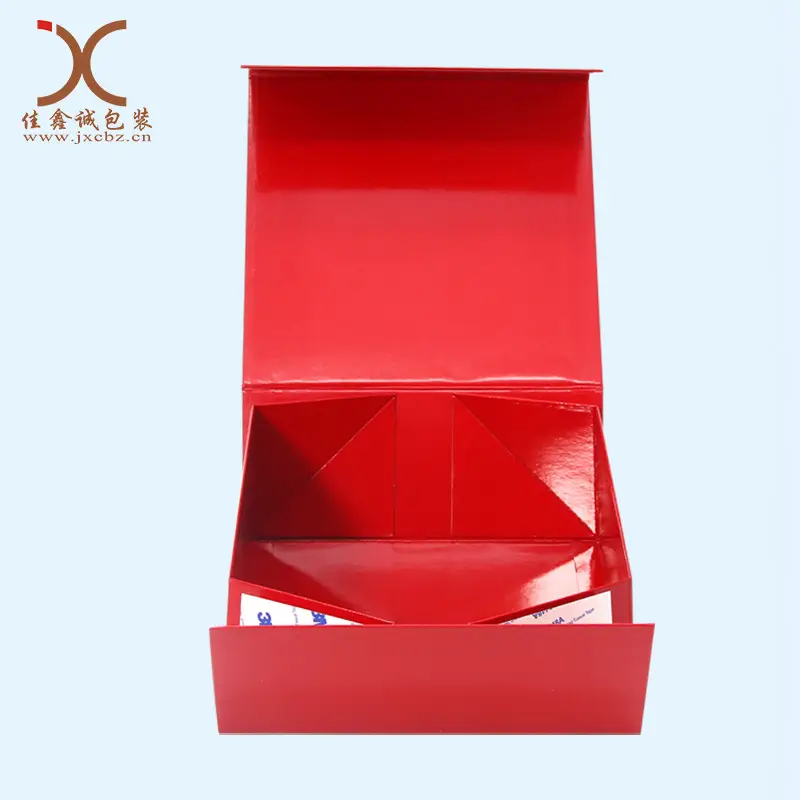
A collapsible rigid box is a rigid box that ships flat and assembles on site. The walls are hinged with a wrapped paper spine instead of being glued up, the base folds down, and the front panel carries two magnets that hold the box closed once built. Assembly is measured in seconds, not minutes, and needs no glue.
Why it matters is volume. A glued rigid box is mostly air: a container filled with assembled boxes carries a fraction of the number of units that the same container carries flat. Collapsible construction is how brands get rigid-box presentation at folding-carton freight cost, and it is the reason the format has spread from gift sets into e-commerce and subscription boxes.
The trade-offs are real and worth stating. A collapsible box has visible fold lines on the wrapped corners, so it reads slightly less monolithic than a glued box. Its load capacity is lower, which matters if the box must stack in a warehouse. And it depends on the customer actually assembling it correctly, so the assembly instruction has to be obvious or printed inside.
Sliding drawer boxes: the reveal
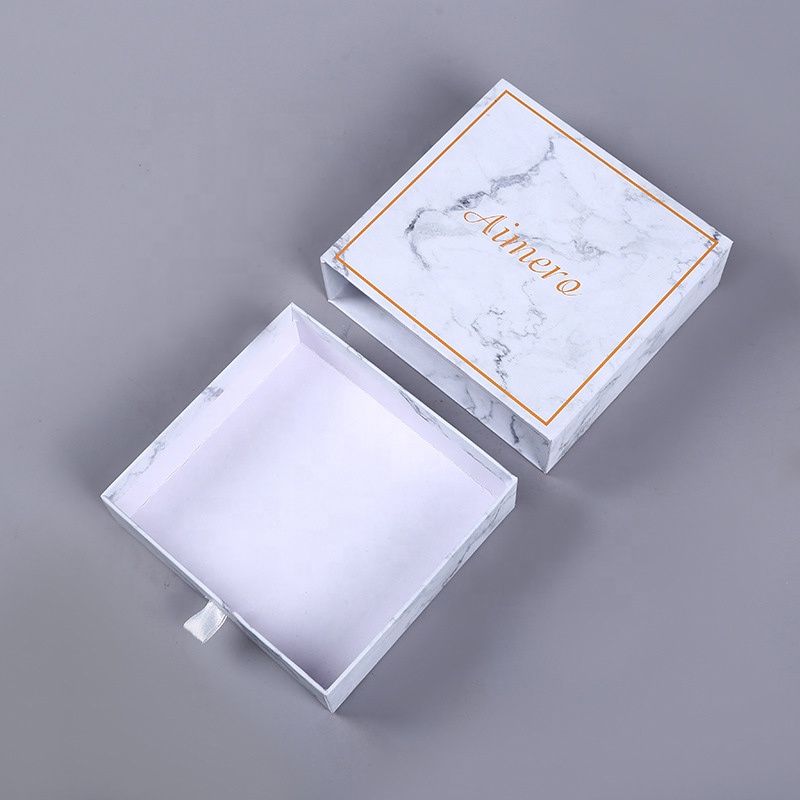
The drawer box is two independent structures: a tube-shaped sleeve and a tray that slides inside it. Nothing is hinged and nothing is glued shut, so the opening action is a slow pull rather than a lift, which is exactly the effect the format is chosen for.
Because the sleeve and tray are separate, the drawer is where tolerance shows. Too loose and the tray slides out in the customer’s bag; too tight and it jams halfway. The fix is a ribbon pull, a thumb notch, or a friction fit specified against the actual board caliper rather than a nominal size.
Common uses are tea and coffee, jewellery and watches, fragrance, small electronics and any product where the tray itself is part of the presentation, because the tray can be divided, flocked or foam-inserted while the sleeve carries the branding.
Choosing the structure
| If your priority is… | Choose | Because |
|---|---|---|
| Lowest freight cost at rigid-box quality | Collapsible rigid | Ships flat, assembles in seconds |
| Strongest perceived value on a shelf | Lid and base or book-style | No fold lines, heavier feel |
| A gift-set reveal for photography and social | Double-door | Two panels open outward from the centre |
| Product stays visible and reusable | Drawer | Tray acts as a display and can be re-used |
| Highest structural protection in transit | Glued lid and base | Continuous walls, no hinges or folds |
Lid styles, and what each one signals
The comparison above is about how a box opens and closes. The lid is a separate decision: it sets the fit, the cost and the first physical impression, and the same base can carry any of six lid styles.
| Lid style | How it sits | What it signals | Cost | Watch out for |
|---|---|---|---|---|
| Lift-off (two-piece) | Lid lifts vertically off a base with an inner neck | Classical, restrained, jewellery-counter | Lowest rigid build | No hinge – needs a finger notch or ribbon pull, and the wrap marks at the lift point |
| Telescoping | Lid slides down over a deeper base | Utility, generous | Low | Forgiving of board tolerance but looks less precise; more material |
| Neck and shoulder | Lid lands on an inner shoulder rather than the base edge | Precision, high-end retail | Higher, more assembly | Shoulder height must match lid depth or the lid sits proud |
| Book-style hinged | Lid attached along one edge, opens like a book | Ceremonial reveal, gift | Moderate, hinge crease control | Needs a spine allowance; artwork must cross the hinge deliberately |
| Sleeve or slipcase | Open both ends, box slides out | Editorial, minimalist | Low | The inner box can slide out in transit without a friction fit or a tab |
| Magnetic flap | Flap wraps from back to front, magnets at the edge | Modern luxury, repeat opening | Moderate | Magnets must engage before the flap seats, or the wrap takes the load |
Why the lift-off box is the default for jewellery
The lift-off, or two-piece, construction is the cheapest way to make a box that looks made rather than folded. It needs no hinge, no magnet and no shoulder, the base can be shallow, and an insert does the work of holding the product. For rings, earrings and small leather goods it is almost always the right starting point.
Four dimensions decide whether it feels precise or cheap. The neck – the inner wall the lid sits over – should be 10 to 15 mm deep; shallower and the lid rocks. Lid clearance should total 0.5 to 1.0 mm across both sides, measured dry, with 0.3 mm allowed for paper moisture expansion. The finger notch wants to be 12 to 15 mm wide and cut through both board and wrap, or the wrap tears at the corner. And the wrap grain should run parallel to the lift direction, so the paper does not fight the lid.
Lift-off or hinged?
Three questions settle it. Does the customer open the box one-handed, in a shop, while holding something else? Then hinged. Is the box kept and reopened – a keepsake, a set, a subscription? Hinged, because a lift-off lid has to be put down somewhere. Is the box mostly a presentation shell that the product leaves once? Lift-off, and spend the saving on the insert and the wrap.
One further note for export orders: a lift-off lid is the easiest style to wrap-separate for recycling, because there is no hinge glue line to cut. Where a market requires clear disposal instructions, that is a practical argument as well as an aesthetic one.
Finishing, and how it changes the cost
All four structures accept the same finishing set, and the finishing is usually where the perceived value is created: hot foil stamping for metallic branding, spot UV for a gloss highlight against a matte wrap, embossing and debossing for tactile logos, and soft-touch film for the velvet hand feel.
Two sequencing rules matter. Stamp before laminating, because foil cannot key through film cleanly. And apply spot UV after lamination, so the gloss sits on the film rather than under it. Both are covered in more detail in the spot UV guide and the lamination guide.
What drives the price
- Board thickness and box size. Rigid boxes are priced on the area of greyboard consumed, so a 20 mm increase in one dimension is not a small change.
- Structure complexity. Each hinge, magnet and door adds assembly labour; double-door is the most labour-heavy.
- Wrap paper. Specialty papers, textured stock and soft-touch film all cost more than standard art paper.
- Inserts. Foam, flocked PET, molded pulp and die-cut board each add a separate tooling and assembly step.
- Quantity. Die-cutting and magnet placement are setup-heavy, so unit cost drops sharply with volume.
QC checklist for rigid boxes
- Wrap alignment: the printed pattern must be centred on all visible panels, including the spine.
- Magnet strength and position: the lid should close with a positive click and hold when the box is shaken gently.
- Corner quality: wrapped corners should be square with no lifting or white edges.
- Hinge endurance: open and close a sample 20 times; the hinge should not crack or delaminate.
- Tray fit on drawer boxes: the tray should slide without binding and not fall out when the sleeve is tilted.
Frequently asked questions
What is the difference between a rigid box and a folding carton?
A folding carton is die-cut from a single sheet of paperboard and folded into shape, so it ships flat and is printed directly. A rigid box is built on greyboard and wrapped in printed paper, so it holds its shape, feels heavier and costs more. The collapsible rigid box is the hybrid: rigid construction that ships flat.
How many magnets does a magnetic closure box need?
Two magnets on the front edge are enough for a small to medium box. Large lids, double-door builds and boxes where the lid must resist springing open in transit normally use four. Magnet strength matters more than count: a weak pair of magnets reads as a defective box no matter how good the wrap is.
Do collapsible boxes look cheaper than glued boxes?
Slightly, because the wrapped corners show fold lines where a glued box shows a continuous edge. The gap closes with a heavier wrap paper and tight tolerance. For most gift and e-commerce applications the difference is invisible to the end customer and the freight saving is substantial.
Can a drawer box be used for shipping?
It can be shipped inside a corrugated outer, but not as the primary shipper, because a sliding tray has no closure. For direct e-commerce despatch, a magnetic or tuck-top corrugated mailer is the better structure.
What is the minimum order for a custom rigid box?
It depends on size, structure and finishing, because die-cutting, magnet placement and wrap printing all carry setup. Rather than quote a number that will not hold, ask for pricing at two or three quantities so you can see where the setup cost stops dominating the unit price.