
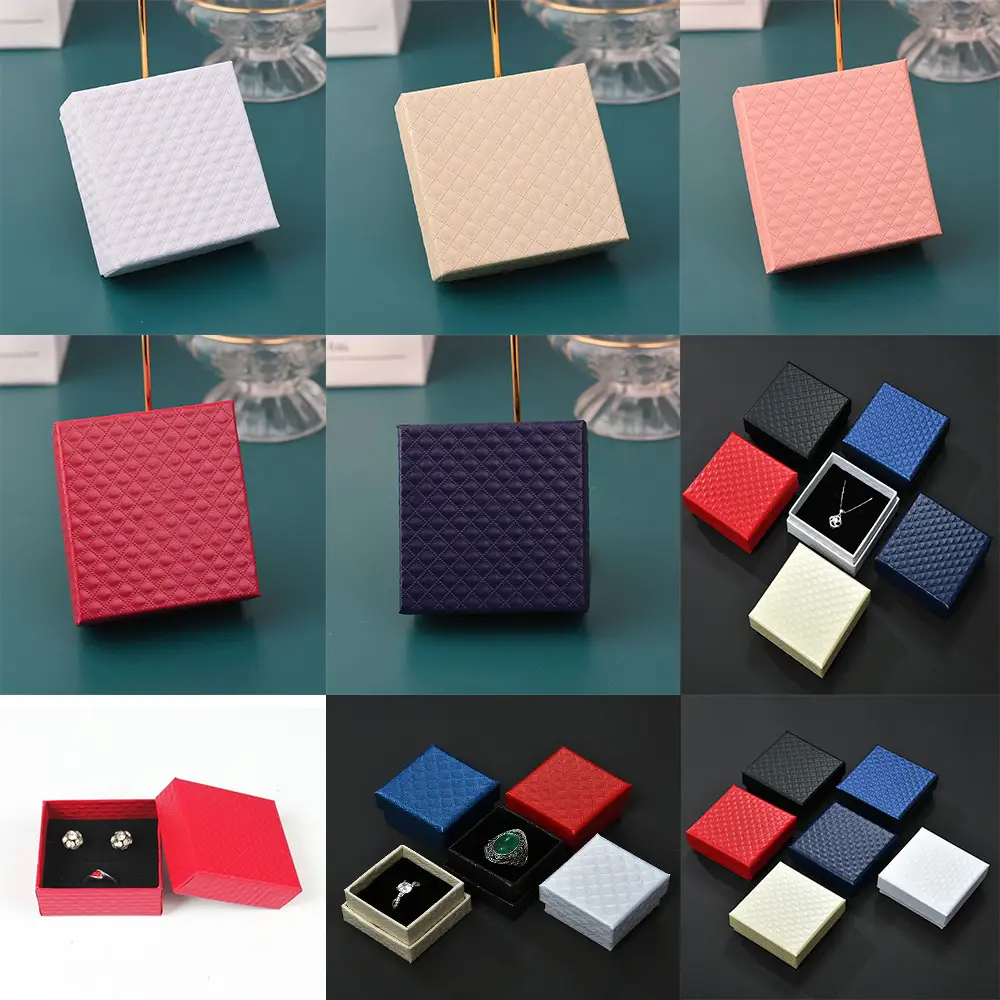
A jewellery box is judged in the first three seconds, before the piece is lifted out. What the hand feels is the drawer action; what the eye sees is whether the ring sits level and whether the lining looks like it was cut for this piece or borrowed from a stock tray. Both are engineering decisions, not styling ones.
Drawer or Lift-Off Lid
| Sliding drawer | Lift-off lid | |
|---|---|---|
| First impression | Slow reveal; the drawer movement reads as quality | Direct; contents visible immediately |
| Structure | Rigid sleeve plus an inner tray | Base plus a separate lid |
| Failure mode | Tray binds or falls out if the fit is loose | Lid loosens with repeated opening |
| Cost | Higher — two assembled parts | Lower |
| Best for | Rings, pendants, single pieces | Sets, earring pairs, bracelets |
The drawer is the more impressive object and the harder one to get right. Its fit depends on the sleeve and tray being assembled from the same board lot: a 0.2 mm caliper difference is enough to turn a smooth glide into a scrape.
Sponge Density: 25 kg/m³ Is the Floor
| Density | Feel | Holds shape | Use |
|---|---|---|---|
| 20 kg/m³ | Very soft, collapses under a ring | No | Padding only, not presentation |
| 25 kg/m³ | Soft but recovers | Yes, for light pieces | Entry-level jewellery boxes |
| 30 kg/m³ | Firm, slight resistance | Yes | The default for retail jewellery |
| 35 kg/m³ | Dense, almost foam board | Yes, with a clean cut edge | Heavy pieces, watches |
Below 25 kg/m³ the sponge compresses permanently under a ring and the slot becomes a dent. Above 35 kg/m³ the cut edge crumbles unless it is die-cut rather than hot-wire cut, and the lining starts to look like industrial foam.
Insert Depth: How Far Below the Rim
The single specification that most affects how a jewellery box feels is how deep the piece sits. Too shallow and the lid presses on the piece; too deep and the piece disappears into the box and looks small.
- Rings and earrings: sit 3–5 mm below the rim of the insert, so the lid closes with clearance but the piece is still fully visible.
- Pendants and chains: 5–8 mm, because the chain needs to be arranged rather than lying flat.
- Bracelets and watches: 8–12 mm, to clear the clasp.
- Anything with a stone that stands proud: add the stone height to the clearance, and check it against the lid depth rather than the rim.
Lining Options
| Lining | Look | Durability | Cost | Note |
|---|---|---|---|---|
| Plain sponge | Utility | Good | Low | Visible cell structure; fine for shipping boxes |
| Flocked sponge | Soft, matte, premium | Good; flock can shed | Moderate | The standard for retail jewellery |
| Flocked foam (EVA) | Crisp cut edges | Excellent | Higher | Best for slots and compartments |
| Satin over sponge | Traditional, glossy | Poor — snags on prongs | Moderate | Avoid with claws and pave settings |
| Moulded pulp | Matte, plastic-free | Moderate | Moderate | For the recyclability brief |
Satin is the one to think twice about. It photographs beautifully and it catches on claw settings every time the piece is removed, which is why most retail jewellery now uses flocked sponge instead — it looks soft without the snag.
Slot Layouts by Piece Type
| Piece | Slot dimensions | Layout note |
|---|---|---|
| Ring | One slot per ring, 25 × 25 mm, 15 mm deep | Cut a finger recess so the ring can be gripped |
| Earring pair | Two slots 15 × 15 mm, 10 mm apart | Keep pair adjacent; separates confuse the eye |
| Pendant | One recess 40 × 30 mm plus a chain channel 5 mm wide | The chain channel matters more than the pendant recess |
| Bracelet | One channel 70 × 20 mm, 12 mm deep | Curve the channel so the piece sits in an arc |
| Watch | One recess 90 × 40 mm with a cushion | The cushion does the work; the recess only locates it |
Paper and Wrap
The wrap on a small box is doing more work than on a large one, because the box is handled at close range. A textured or pearlescent paper hides fingerprints and small scuffs that a smooth matte surface shows immediately. Foil, by contrast, shows every mark and every slight warp in the board beneath it.
For sizes, our stock list is 5 × 5 × 3 cm, 7.5 × 7.5 × 3 cm and 9 × 9 × 2.8 cm, all drawer style, with custom sizes from a new die. The 9 cm box is deliberately shallower at 2.8 cm — it is the size that suits a flat pendant or a pair of studs, and giving it the same 3 cm depth as the smaller boxes would leave the piece lost in the space.
Three Small-Box Production Problems
- Wrap lifting at the corners. Small radii and thick wrap do not get on. Either increase the corner radius or reduce the wrap grammage; pressing harder only delays the lift.
- Sponge shedding onto the product. Hot-wire cutting leaves a friable edge. Die-cutting or sealing the edge solves it; a dark lining hides it, which is not the same thing.
- Drawer binding after two weeks. Board takes up moisture in storage and the tray swells. Pack with a small clearance and store in a dry room, or specify a coated board for the tray.
For the presentation context around the box, the cues that signal value covers which of these details a customer actually registers, and rigid box construction explains the board choices behind the shell.