Most buyers do not start with a specification. They start with a photo, a Pantone number and a rough idea of quantity, then find out that the price depends on six decisions nobody has made yet: paper grade, print method, finishing, handle, structure and order size. Each one changes the number, and several of them change it more than the quantity does.This guide walks through those six decisions in the order they actually affect cost. It is written from the factory side of the table: the questions we ask before quoting, the answers that move the price, and the places where a cheap-looking choice turns out to be expensive later. Read it once and you will be able to write a spec that a supplier can quote in a single round instead of five.
1. What "custom" actually means
A custom paper bag is one made to your dimensions, your paper and your print, rather than pulled from stock. In practice suppliers quote three different levels, and knowing which one you are asking for prevents most misunderstandings.
- Stock bag + logo. An existing size and paper with your artwork printed on it. No new die, no new size. Cheapest per unit, fastest lead time, and perfectly adequate for events, samples and small retail runs.
- Semi-custom. A stock size and structure, but your choice of paper grade, print method and finishing. This is where most brand packaging sits: the bag is the right colour and weight, but the die is shared.
- Full custom. New cutting die, your dimensions, your structure (gusset depth, top folding, base board, handle position). Highest tooling cost, best result, and worth it only when the bag is part of the product experience or the shape saves freight.
2. Bag types, by what the bag has to do
Bag type is usually decided by the retail moment, not by aesthetics. A bag that sits behind a counter for four seconds and a bag a customer carries for two hours across a city are different engineering problems.
Retail and shopping bags
The workhorse: a twisted paper handle, a flat base with a card insert, art paper between 200 and 250gsm. It has to hold weight, stand up on a shelf without collapsing, and print sharply enough to carry a logo at 30cm viewing distance. This is the format where print quality and stiffness both matter, so it is also where the paper grade decision has the biggest effect on how the bag feels in the hand.
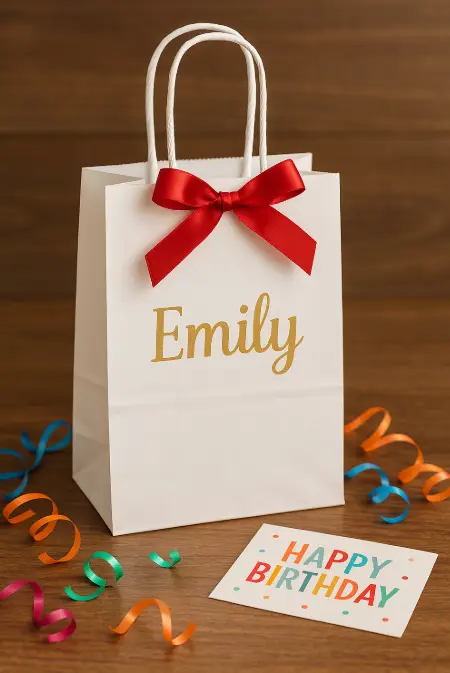
Gift bags
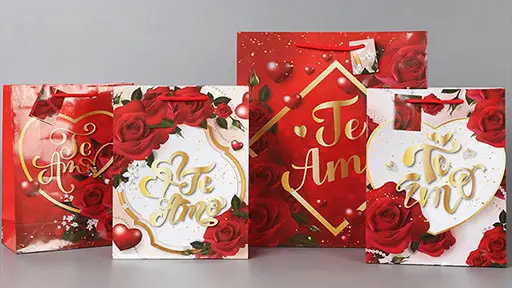
Smaller, softer, and allowed to be more decorative: ribbon or cotton handles, foil stamping, embossing, window patching. Paper usually sits at 157 to 200gsm because the bag carries light contents and a heavier sheet makes the fold at the gusset look bulky. Our gift bag collection covers the common shapes, and there is a separate breakdown of the five main types of paper gift bags if you are choosing between them.
Food and takeaway bags
Kraft, 100 to 150gsm, grease-resistant where needed, food-grade inks, and a flat or block bottom that will not tip over on a counter. Do not laminate a food bag with plastic film if the food is hot: trapped moisture softens the sheet and the bag fails at the handle. Ask for a water-based coating instead.
Luxury and boutique bags
Ivory board at 250 to 350gsm, or art paper laminated to board, with a cotton rope or ribbon handle, a reinforced top edge and often a hidden magnet or a rigid base. These are the bags that get kept and reused, which is why the finishing budget belongs here rather than on the shopping bag.
Promotional and event bags
High volume, one or two colours, flexo printed, kraft or lightweight art paper. Unit cost matters more than longevity. If the bag will be handed out at a trade show and discarded the same week, spending on lamination is money that never reaches the customer.
3. Paper grade and GSM: the decision behind everything else
GSM is grams per square metre. It tells you weight, not stiffness, and the difference matters: two 200gsm sheets can behave completely differently depending on fibre, coating and bulk. Stiffness is what keeps a bag standing up, and stiffness comes from caliper (thickness) as much as from weight.
The four papers you will actually be quoted
| Paper | Typical GSM | Best for | Watch out |
|---|---|---|---|
| Art paper (C2S) | 157 – 300 | Full-colour print, sharp detail, retail bags | Coated surface scuffs; flat colour looks plain |
| Ivory board (FBB) | 230 – 350 | Luxury bags, rigid-feel handles | Cracks on tight folds if scored badly |
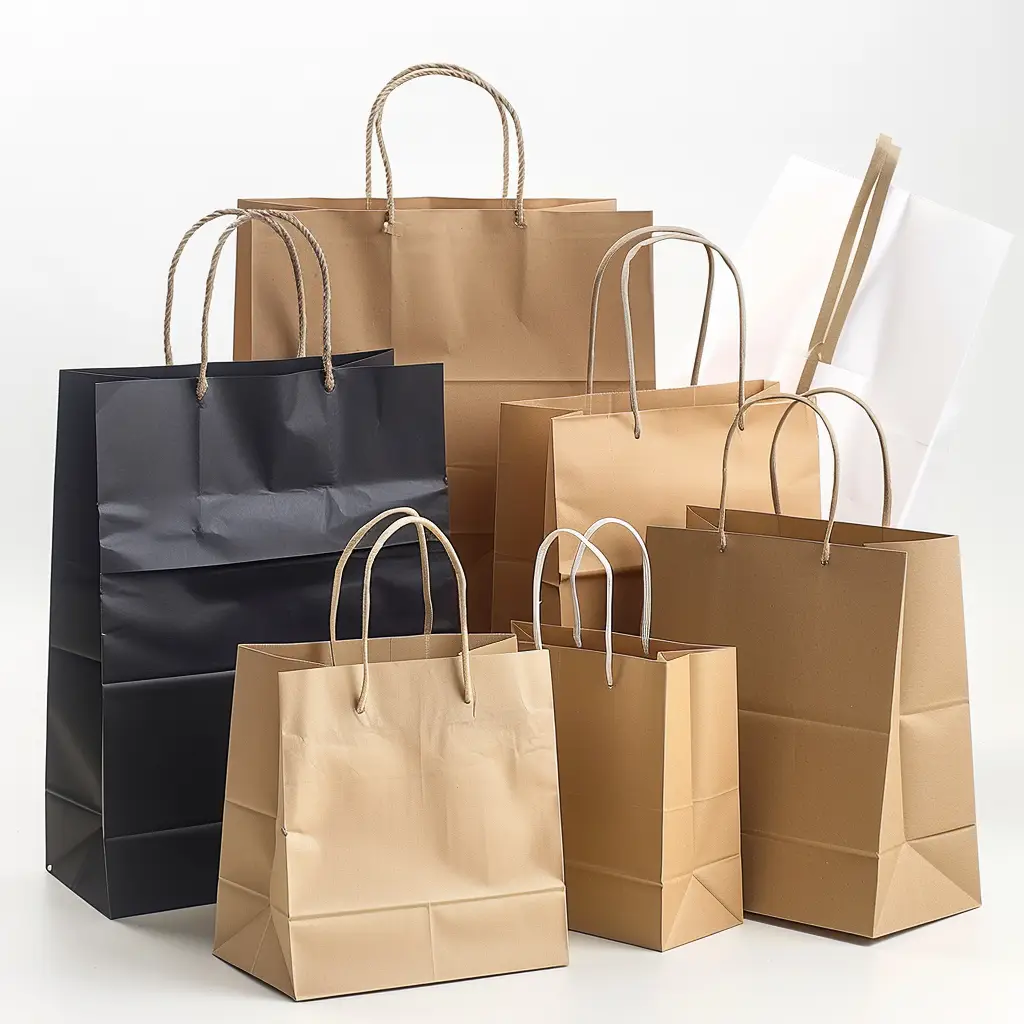
| Kraft (brown / white) | 100 – 180 | Food, natural brands, eco positioning | Absorbs ink; four-colour work looks muddy |
| Specialty (textured, black, metallic) | 120 – 250 | Premium and beauty brands | Usually 20-40% dearer, longer lead time |
GSM by bag size
As a working rule, the sheet has to be stiff enough that the bag does not bow when loaded. Overshoot and the bag feels like cardboard; undershoot and it sags at the handle.
| Bag size (W x D x H) | Art paper | Kraft | Typical load |
|---|---|---|---|
| Small gift, up to 20cm high | 128 – 157 | 100 – 120 | Jewellery, cosmetics, 0.5-1kg |
| Medium, 25-30cm high | 157 – 200 | 120 – 150 | Apparel, accessories, 1-2kg |
| Large retail, 35-45cm high | 200 – 250 | 150 – 180 | Footwear, homeware, 3-5kg |
| Boutique / heavy | 250 – 300 or 2-ply | 180 – 200 | Up to 8kg with reinforced top |
Kraft or art paper: the real trade-off
Kraft announces itself. The fibre texture and warm tone read as honest and unbleached, and for food, coffee, plants and skincare it does more brand work than a four-colour print. The cost is print fidelity: kraft absorbs ink, so fine type fills in and photographs go flat. One or two spot colours on kraft look deliberate; CMYK on kraft looks like a mistake.Art paper is the opposite: it takes ink beautifully and photographs like a magazine page, but a flat-coated surface can feel anonymous unless the finishing does some work. For a broader comparison of coated and uncoated paper, and for the difference between C2S art paper and the boards used in rigid boxes, we have separate notes. If your design lives or dies on a photographic print, art paper is not optional.
4. Printing: offset, digital, flexo, screen
The print method is where most inexperienced buyers lose money, because they compare per-unit prices from two suppliers quoting two different processes on two different quantities. The methods are not interchangeable at every volume.
| Method | Sensible quantity | Colours | Quality |
|---|---|---|---|
| Offset (sheet-fed) | 500 – 100,000+ | CMYK + PMS | Best for photographic work |
| Digital | 50 – 500 | CMYK only | Good, slight grain; no PMS match |
| Flexo | 5,000 – 500,000 | 1 – 3 spot | Solid colour and line work only |
| Screen | 300 – 20,000 | Spot, opaque white | Thick ink, strong on dark stock |
Why 500 pieces is expensive per unit
Offset printing carries a fixed cost: plates, make-ready, and the sheets wasted while the press operator brings colour up to standard. A four-colour job needs four plates and a make-ready of roughly 100 to 200 sheets. At 50,000 pieces that fixed cost is a rounding error. At 500 pieces it can be 40% of the unit price.That is the entire argument for digital printing below about 500 pieces: no plates, no make-ready, so the first piece costs the same as the last. The trade-off is that you cannot match a Pantone exactly, and the paper range is narrower. If you are weighing the two, our note on choosing between offset and digital printing goes through the break-even maths.
Colour: PMS, CMYK and the white ink problem
A brand colour specified in CMYK will drift between runs. If the colour is a logo, specify Pantone and pay for the extra plate. If the artwork is photographic, CMYK is unavoidable and nobody will notice a small shift.Printing white on kraft or black paper needs an opaque white base, usually printed as its own pass, sometimes twice. It is one of the most common omissions in artwork files from first-time buyers: the file looks right on a white screen and disappears on brown paper. Always ask for a printed proof on the actual stock.
5. Finishing: where the bag starts to feel expensive
Finishing is the cheapest way to move a bag upmarket and the easiest way to destroy its recyclability. Both facts matter, so decide which one your brand is optimising for before choosing.
| Finish | Effect | Cost | Recyclable |
|---|---|---|---|
| Matte / gloss film lamination | Scuff protection, premium touch | Low | No, unless certified film |
| Water-based varnish | Light protection, keeps paper feel | Very low | Yes |
| Spot UV | Gloss highlights on matte ground | Medium | Usually yes |
| Hot foil stamping | Metallic logo, highest perceived value | Medium (die + per hit) | Metallic film not recyclable |
| Emboss / deboss | Tactile relief, works without ink | Medium (die) | Yes |
| Window patching | Product visibility | Medium | PLA yes, PVC no |
Matte or gloss
Matte reads as premium and hides fingerprints; gloss makes colour pop and wipes clean, which is why takeaway bags use it. Soft-touch matte is a third option with a velvet feel, but it marks easily and costs more. The gloss versus matte comparison covers the durability side in more detail.
The lamination trap
A BOPP film laminated to a paper bag makes it waterproof, scuff-proof and, in most mills, unrecyclable, because the film cannot be separated from the fibre. If your brand claims recyclable packaging and ships film-laminated bags, that claim will not survive scrutiny. Water-based varnish or a certified recyclable coating gives up some gloss and keeps the claim honest. This is the choice most buyers get wrong, and it is covered in our note on lamination on paper bags.Foil has a similar issue: metallic foil is a plastic carrier film, so a heavily foiled bag is not repulpable. Embossing and debossing give a comparable premium impression with no material penalty, which is why luxury brands increasingly use blind emboss instead of gold foil.
6. Handles: the part that fails first
Almost every bag failure is a handle failure. The paper body rarely tears; the handle pulls out of the top edge, or the hole stretches. Handle choice therefore has to start from load, not from looks.
Whatever the handle, the top of the bag needs help. A three centimetre turn-over, a cardboard insert strip inside the top edge, or eyelets on rope handles all spread the load. For loads above 5kg, ask for both the turn-over and an insert; skipping them saves a few cents per bag and produces complaints.There is a longer comparison of handle construction in our guide to choosing the perfect handle for your paper bag.
| Handle | Practical load | Look | Notes |
|---|---|---|---|
| Twisted paper | 3 – 5kg | Standard retail | Cheapest, recyclable, colour-matched |
| Flat paper | 3 – 4kg | Wide, printed | Good for logo on the handle |
| Cotton / rope | 8 – 10kg | Premium, boutique | Needs eyelets and a reinforced top |
| PP rope | 5 – 8kg | Cheerful, coloured | Plastic; conflicts with paper claims |
| Ribbon / satin | 1 – 3kg | Gift, delicate | Knots pull through unless reinforced |
| Die-cut (integral) | 1 – 2kg | Minimal, clean | No extra material; sharp edges on thin stock |
7. Size and structure: how to specify a bag correctly
Bags are quoted as width x depth x height, measured on the outside, with height excluding the handle. A “25 x 11 x 32cm” bag is 25cm wide, 11cm deep at the gusset and 32cm tall. Suppliers will assume this order; sending dimensions in a different sequence is the single most common cause of a wrong-size sample.
Sizing from the product, not from the shelf
Take the largest product the bag must hold, add 1 to 2cm on each dimension for hands and tissue paper, and round to the nearest standard size. A bag that fits the product exactly looks cramped and is slow to pack; 3cm of slack looks empty. If the product is a box, remember that the box corner is what stresses the bag, so depth matters more than width.
Sizes that are already tooled
These are the sizes we cut most often, and using one avoids a die cost:
| Use | W x D x H (cm) | Holds |
|---|---|---|
| Small gift | 15 x 8 x 21 | Jewellery, small cosmetics |
| Wine / bottle | 11 x 11 x 35 | Single bottle, with neck clearance |
| Boutique medium | 25 x 11 x 32 | Apparel, accessories, gift sets |
| A4 documents | 25 x 9 x 33 | Paperwork, flat products |
| Large retail | 32 x 12 x 41 | Footwear, homeware |
| Garment / bulky | 40 x 15 x 45 | Coats, bedding, soft goods |
Structure details worth specifying
- Base board. A grey board insert keeps the bottom flat and lets the bag stand unaided. Essential above 2kg, optional for gift bags.
- Top turn-over. 2.5 to 4cm folded over at the opening. Without it the top edge curls after a few carries.
- Gusset crease quality. Sharp creasing matters more on heavy stock; a bad crease cracks the coating on ivory board within weeks.
- Side gusset depth. Anything under 8cm will not take a box; anything over 15cm wastes shelf space.
- Handle position. Centred by default. Move it inward for wide bags or the bag tips forward when carried.
8. MOQ, tooling and lead time
Minimum order quantity is not a policy, it is arithmetic. Below a certain volume the fixed costs (plates, dies, make-ready, machine set-up) exceed the value of the order, so the factory either declines or prices it so high that it functions as a decline.Our minimum order is 500 pieces per design. That number is not arbitrary: it is roughly where offset printing stops being disproportionately expensive, and where a paper mill will supply the sheet without a surcharge. Below it, digital printing on a stock size is the only route that makes economic sense, and we will say so rather than quote a price that quietly funds the set-up.
| Set-up | What sets the floor |
|---|---|
| Digital print, stock size | No plates, no make-ready, but machine time is fixed, so small runs are only viable on the cheapest paper |
| Offset, stock size | Plates, make-ready waste and the mill’s sheet minimum: 500 pieces is where the fixed cost stops dominating |
| Offset, new die | Adds die cost and a sampling round, so volume has to absorb both |
| Flexo, kraft | Cylinder engraving is expensive; only pays off in the thousands |
| Foil / emboss add-on | Die cost is fixed, so the per-piece effect shrinks with quantity rather than with the bag |
Tooling you pay for once
- Cutting die for a new bag shape: a one-off charge, quoted by die complexity and size. It is reusable, so the cost is only paid on the first order.
- Offset plates: charged per colour. This is the real reason a one-colour bag is materially cheaper than a four-colour bag at low volume.
- Foil and emboss dies: one-off, sized by the artwork area rather than by quantity.
- Screen frames, if the job is screen printed: one per colour.
Timeline to expect
Artwork check, 1 to 2 working days. Digital sample, 3 to 5 working days including courier. Bulk production, 15 to 20 working days for offset printed bags, longer for hand-assembled luxury bags or during peak season. Sea freight to Europe or the US, 25 to 40 days. If your launch date is fixed, work backwards from freight, not from production.
9. How the price is actually built
A paper bag quote is a stack, not a single number. Ranked by how much each layer moves the total:
- Paper. The largest single share, and the lever with the most room. Grade, GSM and coating decide most of the unit price before a single sheet is printed.
- Printing. Second, and driven by colour count and ink coverage rather than by bag size. A solid flood colour costs more than a small logo on white.
- Finishing. Third. Film lamination and metallic foil cost several times what water-based varnish or an emboss does.
- Assembly. Rope handles, glued inserts, window patching and hand-folded luxury bags are handwork, and handwork is priced in time, not material.
- Packing and freight. Cartons, pallets and how well the bags nest into a container. On small orders this can rival the paper cost per bag.
Eight levers that actually reduce cost
- Cut a colour. Four down to three is the cheapest saving available and rarely visible on shelf.
- Swap film lamination for water-based varnish: less money, less weight, and it keeps a recyclability claim alive.
- Use a tooled size instead of a new die, saving both the die and the sampling round.
- Move the handle inside the top turn-over rather than adding a card insert on light bags.
- Consolidate SKUs: one bag in three print variants beats three bag sizes.
- Commit to annual volume with quarterly releases, which lets the factory buy paper at a better price.
- Ship full container loads where possible; less-than-container freight per bag is brutal on small orders.
- Reduce air: nesting bags tightly in the carton is the only freight saving that costs nothing.
10. Sustainability claims that survive scrutiny
Paper is not automatically the sustainable option, and regulators have stopped accepting the assumption. Three things decide whether a bag is defensible:
- Sourcing. FSC Mix or FSC 100 with a chain-of-custody certificate number you can check. If a supplier cannot produce the certificate for the exact paper used, the claim is marketing.
- End of life. Uncoated or water-varnished paper repulps cleanly. Film lamination, metallic foil and PVC windows do not. A bag is only recyclable if every component is.
- Recycled content. Post-consumer recycled kraft is widely available and slightly dearer; state the percentage rather than saying “recycled”.
11. Vetting a supplier, and the mistakes buyers repeat
The difference between two suppliers quoting the same specification is usually not price, it is what they quietly left out. These ten questions surface it before you pay a deposit.
- Which mill supplies the paper, and what is the GSM tolerance? (Plus or minus 5% is normal.)
- Can you send a printed dummy on the actual stock, not a digital mock-up?
- Do I own the printing plates and the die, and will you store them free of charge?
- What pull strength does the handle pass at, and do you test it per batch?
- How do you control colour: densitometer readings, visual match, or a Delta E limit?
- What is the master carton count and the pallet specification?
- Will you send QC photos of the finished goods before shipment?
- What is the realistic production window in your peak season, not in your brochure?
- What are the payment terms, and is a third-party inspection allowed?
- What happens if 3% of the order has a defect: credit, replacement, or nothing?
Six mistakes that cost real money
- Specifying GSM only. Stiffness, not weight, is what keeps the bag upright. Ask for caliper if the bag is large.
- Artwork without bleed. 3mm minimum, and a separate dieline layer for anything that folds.
- Forgetting the handle hole. It sits inside the top turn-over; artwork placed there disappears.
- Ordering exactly what you need. Add 3 to 5% for damage and samples. Reorders carry a new make-ready cost.
- Mixing RGB and CMYK. A logo designed in RGB will shift when printed. Convert before approval, not after.
- Approving a digital proof for a kraft bag. Brown stock changes every colour on it. Only a printed proof on the actual paper counts.
Frequently asked questions
How many custom paper bags should I order for a first run?
Our minimum is 500 pieces per design, and that is also the sensible first order: enough to get offset quality and a stable unit price, small enough to test a size and a print before committing to a full season. Add 3 to 5% for damage and samples. If 500 is more than you can sell through, the honest answer is to launch with a stock bag and save the custom run for the volume you are confident about.
How do I make a cheap bag look expensive?
Spend on the handle and the top edge, not on more colours. A matte bag with a cotton rope handle and a clean blind emboss reads more premium than a glossy four-colour bag with a twisted paper handle. Reducing the palette to one colour plus paper texture is the most reliable upgrade at low cost.
Can custom paper bags be recycled?
Yes, if the bag is paper and paper only. Uncoated or water-varnished stock with a paper handle repulps normally. Film lamination, metallic foil, PVC windows and PP rope handles all break the claim; PLA windows and paper handles keep it. Check the mill’s repulpability statement rather than trusting the word recyclable.
What is the difference between art paper and ivory board?
Both are coated, but ivory board is a multi-layer board with a stiffer core, so it holds a shape at a lower weight. Art paper is a single-layer coated sheet that prints with more detail and folds more easily. For a luxury bag use ivory board at 250 to 350gsm; for a printed retail bag art paper at 200 to 250gsm is usually enough.
Can you print white on kraft paper?
Yes, with an opaque white base printed underneath the colour, sometimes in two passes. It adds a plate and a pass, so it costs more, and it is the reason a logo that looks fine on screen vanishes on brown stock. Always approve a proof on kraft.
How long does production take?
Our digital sample takes 3 to 5 working days including courier, bulk production 15 to 20 working days after sample approval, and sea freight to Europe or the US a further 25 to 40 days. Add a week for artwork iteration and a little more if your order lands in the third quarter, when every factory in the industry is queuing for the same paper.
Ready to price your bag?
Send us five things and we can quote in one round: size in W x D x H, quantity, paper preference if you have one, print and finishing notes, and your artwork or a reference image. If you have not decided yet, tell us what the bag has to carry and we will propose two specifications at different price points.Request a quote