
The EU’s Packaging and Packaging Waste Regulation (PPWR) is the biggest shift in European packaging law in decades. Here’s everything B2B buyers and packaging buyers need to know — timelines, targets, and what it means for your supply chain.
What Is PPWR — and Why Does It Matter Right Now?
If you sell products in Europe — or source packaging from China for the European market — 2024 changed everything. The EU adopted the Packaging and Packaging Waste Regulation (PPWR), a sweeping new law that replaces the old 1994 Packaging Directive and introduces mandatory recyclability, recycled content minimums, reuse targets, and Extended Producer Responsibility (EPR) for all packaging sold in the EU.
Unlike a directive (which EU member states could interpret differently), a Regulation is directly enforceable across all 27 EU member states from day one. There is no room for delay or loose interpretation. Businesses that fail to adapt risk non-compliance penalties — and losing access to one of the world’s largest consumer markets.
This guide breaks down what PPWR means for packaging buyers, brand owners, and their supply chains — with clear timelines and practical steps you can take today.
The 5 Core Pillars of PPWR
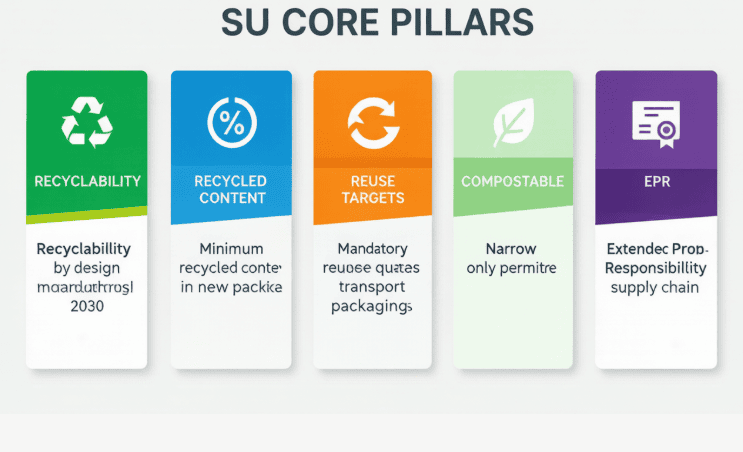
1. Mandatory Recyclability — “Recyclable by Design”
From January 1, 2030, ALL packaging placed on the EU market must be recyclable. This is not optional. By January 1, 2035, it must meet “recyclability at scale” standards — meaning recycling infrastructure must actually exist for that packaging type at commercial scale.
What this means for your packaging:
- Multi-material laminates (e.g., plastic-aluminum foil pouches) may be restricted or banned
- Black plastic trays (carbon black pigments block sorting machines) will be phased out
- Packaging must be designed for easy separation of components (paper, plastic, metal layers)
- Glossy/metalized barriers may阻碍回收 — paper-based with water-based barriers are preferred
2. Minimum Recycled Content Targets
To close the loop on plastic packaging, PPWR mandates that manufacturers include a minimum percentage of recycled material in new packaging. This applies to contact-sensitive packaging (food, cosmetics) where safety is paramount.
| Packaging Type | 2030 Target | 2040 Target |
|---|---|---|
| Contact-sensitive plastic packaging | 10% | 25% |
| Non-contact-sensitive plastic packaging | 10% | 50% |
| Plastic beverage bottles | 25% | 50% |
| Single-use beverage bottles (rPET) | 25% | — |
For packaging manufacturers, this means sourcing recycled plastics and paper fibers — and being transparent about content percentages in technical specifications.
3. Reuse and Refill Targets
PPWR sets mandatory reuse targets for specific packaging categories, pushing brands to shift from single-use to reusable models.
| Category | 2030 Target | 2040 Target |
|---|---|---|
| Transport & shipment packaging (e-commerce, B2B) | 10% reuse | 20% reuse |
| Grouped packaging (multi-pack beverages, etc.) | 10% reuse | 20% reuse |
| Restaurants & catering (reusable tableware) | 20% reuse | 80% reuse |
For B2B buyers, this means your secondary packaging (shipping boxes, filler materials, tape) must increasingly shift toward reusable or returnable formats. Packaging suppliers who offer reusable mailer boxes, returnable totes, or modular designs will have a competitive edge.
4. Compostable Packaging — Narrow Scope
Contrary to some misconceptions, PPWR does not open the door to wide-scale compostable packaging adoption. The regulation permits compostable packaging only in very limited categories:
- Tea bags and coffee pods/capsules
- Fruit and vegetable stickers (labels on fresh produce)
- Very lightweight plastic bags (below 15 microns for primary food packaging)
All other compostable claims for packaging will require EU-level assessment and approval. Brand owners who have invested heavily in compostable as a sustainability strategy may need to reassess — particularly for cosmetic boxes, paper bags, or gift boxes where compostability is not recognized under PPWR.
5. Extended Producer Responsibility (EPR)
PPWR strengthens EPR schemes across the EU. Producers (manufacturers, importers, and brands selling packaged goods in the EU) must now financially cover the full lifecycle cost of packaging — including collection, sorting, and recycling. This applies to both EU-based companies and non-EU suppliers whose products enter the EU market.
Key implications:
- Packaging buyers sourcing from China must ensure their supplier provides proper documentation and material declarations
- Germany has already implemented strict EPR enforcement — the Verpackungsgesetz (VerpackG) requires full EPR registration for all sellers into Germany, with Stiftung Zentrale Stelle clearing house managing compliance
- Purchasing recycled-content or recyclable-only packaging reduces EPR fee burdens
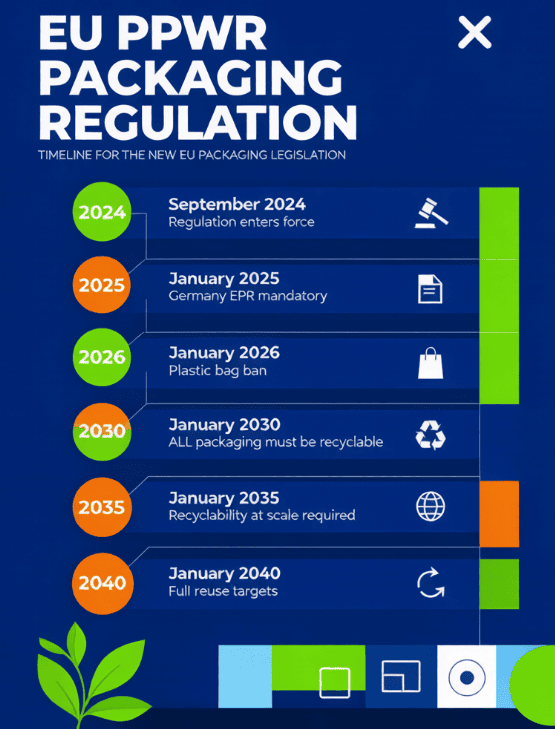
PPWR Timeline — Key Dates to Mark
| Date | Requirement |
|---|---|
| September 2024 | PPWR enters into force. Regulation becomes applicable across all EU member states. |
| January 2025 | Germany: mandatory EPR registration for all marketplace sellers (including non-EU sellers). Private label brands must declare packaging materials. |
| January 2025 | Restriction on expanded polystyrene (EPS) in secondary packaging for beverages and food takes effect. |
| January 2026 | Plastic bag ban in the EU (remaining member state restrictions). Very lightweight plastic bags below 15 microns also restricted. |
| January 2030 | ALL packaging must be recyclable. Recycled content minimums apply. Reuse targets for transport packaging kick in (10%). |
| January 2035 | Packaging must meet “recyclability at scale” — actual commercial recycling infrastructure must exist for that packaging type. |
| January 2040 | Full reuse targets apply. Recycled content targets increase significantly across all packaging types. |
What This Means for Brands Sourcing from China
If you are a European brand or importer buying packaging from Chinese manufacturers like Hrenary Packaging, PPWR has direct implications for your supplier relationship:
- Supplier declarations: You will need written confirmation from your Chinese supplier that packaging materials comply with EU recyclability standards. Technical data sheets (TDS) and material declarations become essential documents.
- Recycled content sourcing: As recycled content minimums tighten, Chinese manufacturers who already use recycled paper fibers or rPET in their production will be better positioned to serve EU buyers.
- Design for recyclability: Packaging designed with PPWR compliance in mind — single-material paper boards, water-based coatings, easy-separation layers — will increasingly be required. Complex multi-material laminates that cannot be recycled may be rejected by EU buyers.
- Documentation and transparency: PPWR calls for digital product passports (by 2030) — QR codes or RFID chips on packaging linking to material composition, recyclability data, and recycled content certificates.
- EPR chain responsibility: EU importers are responsible for EPR registration. Working with a compliant Chinese manufacturer who can provide the necessary technical documentation simplifies your compliance significantly.
How Hrenary Packaging Supports Your PPWR Compliance
As a manufacturer with over 13 years of experience exporting to the EU and worldwide, Hrenary Packaging is actively adapting our product lines and processes to support our clients’ PPWR compliance journey.
- Recyclable materials as default: Our standard paper-based packaging — folding cartons, rigid boxes, paper bags — is already designed for recyclability. We use single-material paper boards and water-based coatings wherever possible.
- Recycled content available: We can supply FSC-certified recycled paper board and incorporate specified percentages of recycled content in your packaging upon request.
- PPWR-aligned design support: Our in-house design team can review your current packaging and recommend modifications to meet EU recyclability standards before production.
- Material documentation: We provide full material data sheets, FSC certificates, and compliance declarations for every order — essential documentation for your EPR registration and EU market entry.
- Food-safe, compliant materials: All food-contact packaging from Hrenary uses food-grade materials and compliant inks, with documentation available for EU regulatory requirements.
- Modular, reusable packaging options: We offer reusable mailer boxes, returnable rigid box designs, and modular packaging systems for brands looking to meet the reuse targets set by PPWR.
PPWR Compliance Checklist for Packaging Buyers
Use this checklist when reviewing your current and future packaging supply chain:
- ☐ Audit your current packaging portfolio: identify multi-material laminates, black plastics, or hard-to-recycle components
- ☐ Check your supplier’s recyclability declarations and material certifications (FSC, SGS reports)
- ☐ Verify that your Chinese supplier can provide documentation for EU EPR purposes
- ☐ Plan for recycled content minimums — start sourcing from suppliers who can meet 2025-2030 targets
- ☐ Review your secondary packaging (e-commerce shipping boxes, void fill) for reuse potential
- ☐ Register with the relevant EPR scheme for each EU country where you sell (Germany: Stiftung Zentrale Stelle; France: CITEO; etc.)
- ☐ Engage your packaging supplier early — design changes made before production are far less costly than re-tooling post-production
Sustainability as a Competitive Advantage
PPWR is the most significant regulatory shift in European packaging in a generation. For brands, it can feel like a compliance burden — but forward-thinking businesses see it differently.
Packaging that is recyclable, contains recycled materials, and is designed for circularity is not just compliant packaging — it is better packaging. It protects your brand reputation with environmentally conscious consumers. It reduces your long-term EPR costs. And it positions your products ahead of the regulatory curve in every EU market.
The brands that act now — redesigning their packaging supply chain ahead of the 2030 deadline — will be the ones who turn compliance into a competitive advantage. The window to act is now.
Ready to Discuss PPWR-Compliant Packaging?
At Hrenary Packaging, we are committed to helping our clients navigate the transition to sustainable, regulation-ready packaging. Whether you need recyclable rigid boxes, FSC-certified paper bags, or a full packaging redesign for PPWR compliance, our team is ready to support you.
Get in touch today for a free consultation and PPWR compliance review of your current packaging.
📧 sales@hrenarypackaging.com
📱 WhatsApp: +86 178 0272 6061
🌐 www.hrenarypackaging.com