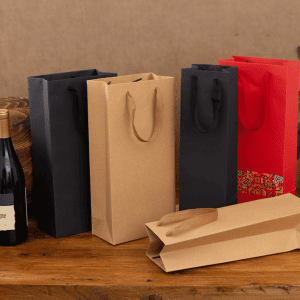
How to Choose a Paper Bag
A paper bag is a walking billboard, but it is also a load-bearing structure. The handle type decides how much weight the bag can carry, the paper stock decides how it feels in the hand, and the print method decides whether the brand colour survives a full day of shopping. Five specifications settle most briefs: handle style, paper stock and GSM, print method, finish, and load rating.
Handle Styles and What Each One Carries
Twisted Paper Handle Bags
A twisted kraft cord glued into a reinforced paper patch. The most common retail bag worldwide: comfortable on the hand, recyclable as a single paper item, and cheap to produce. Practical load limit is around 5–8 kg on 150 gsm stock with a properly sized patch.
Die-Cut and Patch Handle Bags
A die-cut hole reinforced with a PP or paper patch, or a moulded plastic handle clipped through. Sits flat and stacks well, which is why it dominates fashion and grocery retail. Plastic patch handles carry more weight but compromise an all-paper recyclability claim.
Rope Handle Bags
Cotton, PP or jute rope threaded through eyelets or a folded top hem. Cotton rope reads as premium and pairs naturally with coated art paper and luxury retail. Load capacity is high, but the eyelet is the weak point and must be reinforced.
Flat Handle (SOS) Bags
The classic grocery bag: flat paper handles, block bottom, ships flat in cartons. Cheap, fast to pack, and the standard for food service and takeaway.
Ribbon Handle Bags
Satin or grosgrain ribbon threaded through punched holes. The most formal option and the usual choice for jewellery, bridal and cosmetics counters. Ribbon is decorative rather than structural — keep loads light.
Luxury Rigid Bags
Greyboard walls wrapped in printed paper, with a ribbon or rope handle. These hold their shape when empty, which is precisely what makes them read as luxury. They ship assembled and cost accordingly.
Paper Stock: Kraft, Art Paper and Specialty Board
Kraft paper at 100–150 gsm gives an uncoated, natural surface that takes one- or two-colour print beautifully — the default for eco-positioned brands. White art paper at 128–157 gsm, usually laminated, holds full-colour photography and is the standard for retail fashion. Specialty stocks such as textured, metallic, recycled and black-through paper are used as a face layer over a stiffer base, so you get a distinctive hand without sacrificing strength. For bags that must resist moisture, PE-coated or water-based barrier coatings are available.
Printing, Lamination and Finishing
Offset printing handles full-colour and Pantone work; flexo suits high-volume single or two-colour kraft bags at lower cost. Lamination — matte, gloss or soft-touch — protects the print and changes the hand-feel entirely. On top of that we run spot UV, hot foil, embossing and window patching for food and gift bags that need to show the product.
Load Capacity and Handle Strength
Load rating is set by the weakest element, not by the paper alone. A 150 gsm bag with a properly reinforced twisted handle holds 5–8 kg; a 200–250 gsm bag with a cotton rope handle and reinforced eyelets handles 10–15 kg. Undersized patches and un-reinforced eyelets are the two most common causes of field failures. If the bag will carry bottles or dense retail goods, state the load and we will size the handle and patch to match.
MOQ, Sampling and Lead Times
Minimums start in the low thousands for printed bags, because bag making runs on a separate line from box production and setup cost is volume-sensitive; plain kraft stock bags can go lower. Samples take 5–7 working days after artwork approval, and production runs 15–25 days depending on printing method and finishing.
Frequently Asked Questions
What GSM paper should I use for a retail shopping bag?
128–157 gsm art paper for fashion and cosmetics; 150–200 gsm kraft for a natural look and heavier loads. Anything below 120 gsm is usually too flimsy for retail use.
Are paper bags with handles recyclable?
Yes, if the handle and patch are paper. PP rope, plastic patch handles and laminated film mean the bag has to be separated before recycling — worth stating explicitly if you claim recyclability on pack.
Can you print on both sides?
Yes, at additional cost. Double-sided print is common for bags that sit flat on a shelf and need to work from two angles.
What is the difference between twisted paper and cotton rope handles?
Twisted paper is cheaper and fully recyclable; cotton rope is softer, stronger and reads as premium. The choice usually follows the retail channel rather than the price.
How do I know the bag will not break?
Ask for a load test on the pre-production sample. We test handles and seams at the specified load plus a safety margin.